
I recently met with a group of podcast ad buyers and sellers to talk about podcasts, advertising, and audience verification.
"Show of hands," I prompted, "Who skips podcast ads?"
Everybody in the room raised their hands.
I wasn't surprised. Podcast ad avoidance is a well-documented phenomenon. Recently, The Canadian Podcast Listener survey found that 18% of podcast consumers claim to skip podcast ads "all the time." According to 2024 research from Sounds Profitable, "46% of listeners say they 'always or often' skip ads on podcasts."
But as that same study also points out: "Most consumers tend to overstate how often they skip ads when asked hypothetical questions."
What people say vs. what people do
Whenever I see survey-based research into podcast ad skipping, I wonder how respondents' answers line up with the podcast consumption data provided by playback apps.
Apple, Spotify, and YouTube all provide podcasters with episode retention histograms. These allow podcasters and their ad sales representatives to go beyond industry averages, and understand the performance of their specific shows and episodes.
Let's look at a retention histogram chart for an example episode. It shows a common pattern: most listeners are present at the beginning, with sharpest dropoff in the first minute, then gradual attrition throughout the episode:
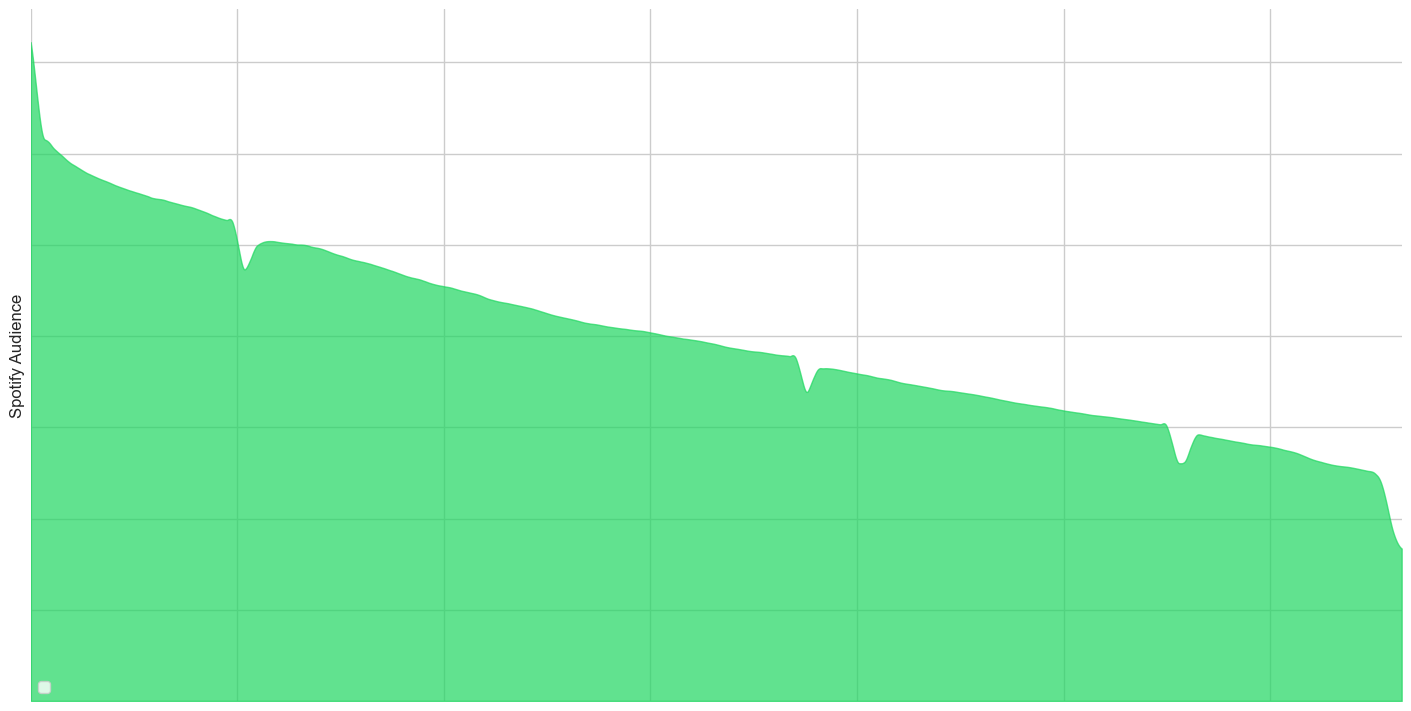
This retention chart also clearly shows ad avoidance patterns across three midroll ad breaks. As humans, we can spot these ad avoidance patterns using our eyes (and ears). Or we can use digital signal processing techniques to find these patterns for us:
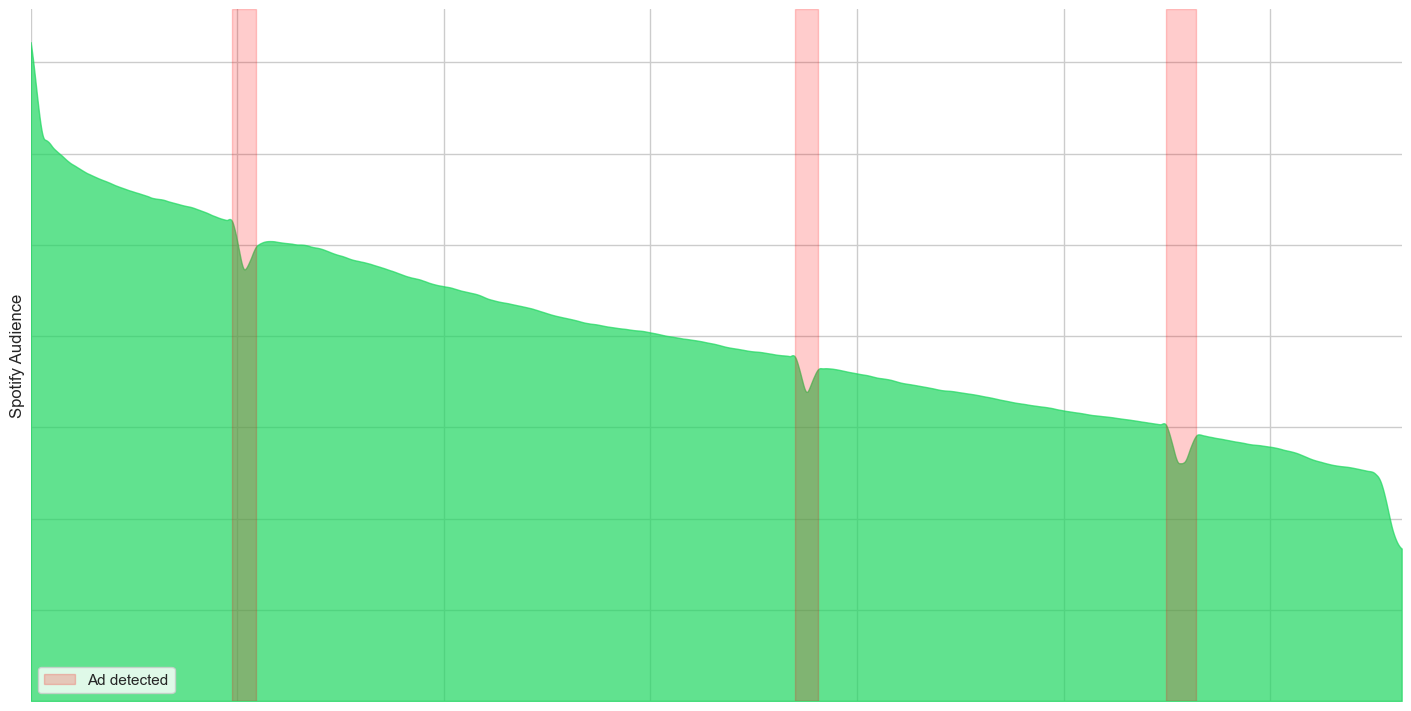
For each detected ad break, we can measure the number of people present, and compare that to the number of people who likely would have been present had they not avoided the ad.
Given the natural audience attrition throughout the episode, the difference between ad seconds played and potential ad seconds played is different at every point in the episode. And while this delta is commonly known as "ad skipping" or "ad avoidance," I think we could frame it in more positive terms, such as...
Podcast ad retention
"How many people heard my ad?" This is a perfectly reasonable but surprisingly difficult question to answer. Ad impressions (and the IAB’s “ad delivered” metric) can only tell us about the delivery of ads, not the playback of ads, though Apple's recently-announced support for HLS delivery may improve the situation.
Podcast ad retention considers the number of people present during the ad break, and compares that to the number of available audience members present elsewhere nearby in the episode.
This is closely related to the broadcast concept of "commercial audience" (the number of people watching the ads) vs. "program audience" (the number of people watching the program).
Let's look at our sample episode again, and quantify the ad retention for each midroll ad break:
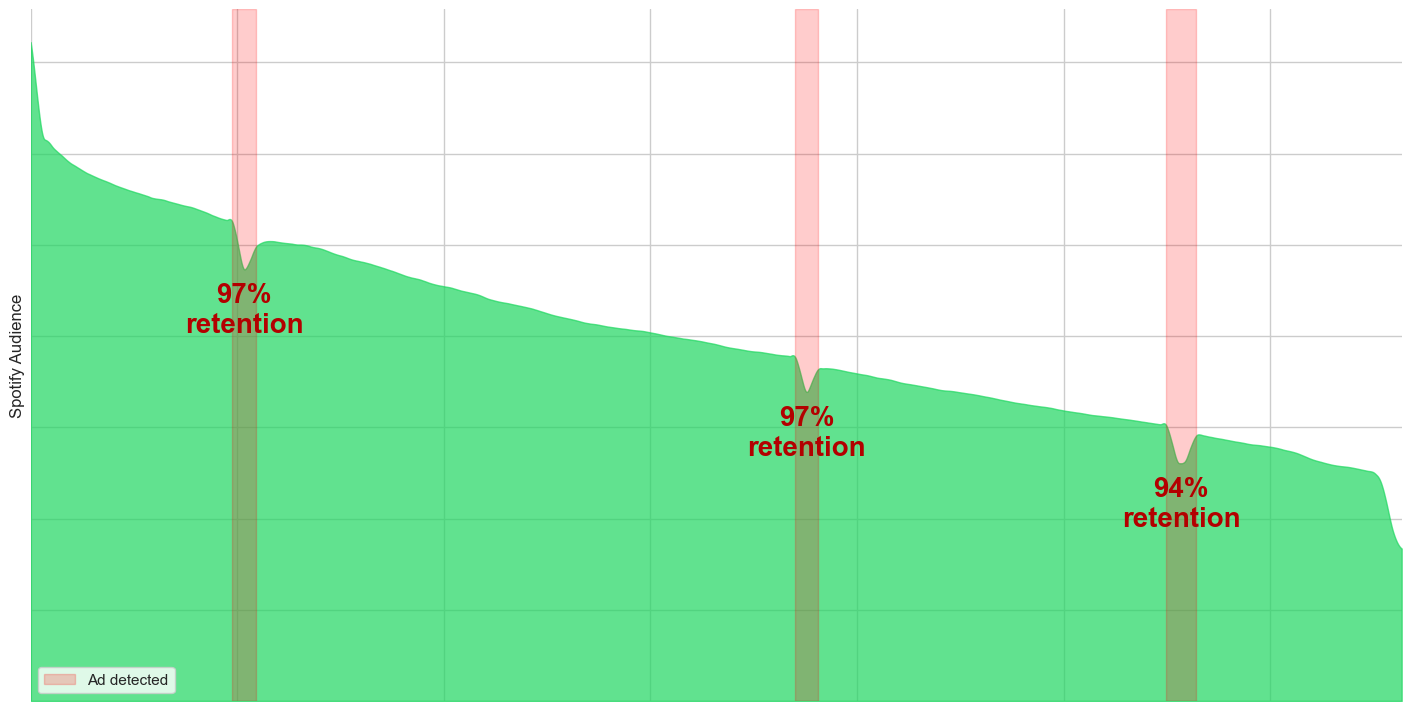
This is an episode with well-executed ads, and the results speak for themselves: very low ad avoidance, and very high ad retention. I've run these numbers for many of Bumper's clients, and we regularly see ad retention of 90% or greater.
That's amazing. Name another medium where ad retention is this high.
Podcasting commands tremendous attention. Podcast advertisers benefit from this level of engagement. Many shows have a wonderful retention story to share with those advertisers.
Are my ad breaks too long? Too short?
Bumper works with publishers and advertisers to verify audiences and increase ad effectiveness. That means clients frequently ask us about the placement and duration of their ad breaks.
"Should we move them earlier? Later? More ad breaks? Fewer?"
Of course, there's no one-size-fits-all answer to these questions. But I was curious about the relationship between ad retention and ad break length. So I analyzed hundreds of ad breaks within recently-published episodes, and plotted ad break duration relative to ad avoidance percentage.
Each point on this scatterplot represents an ad break. The darkest clusters with the greatest number of ads sit at the 60 and 90-second marks (two very common durations).
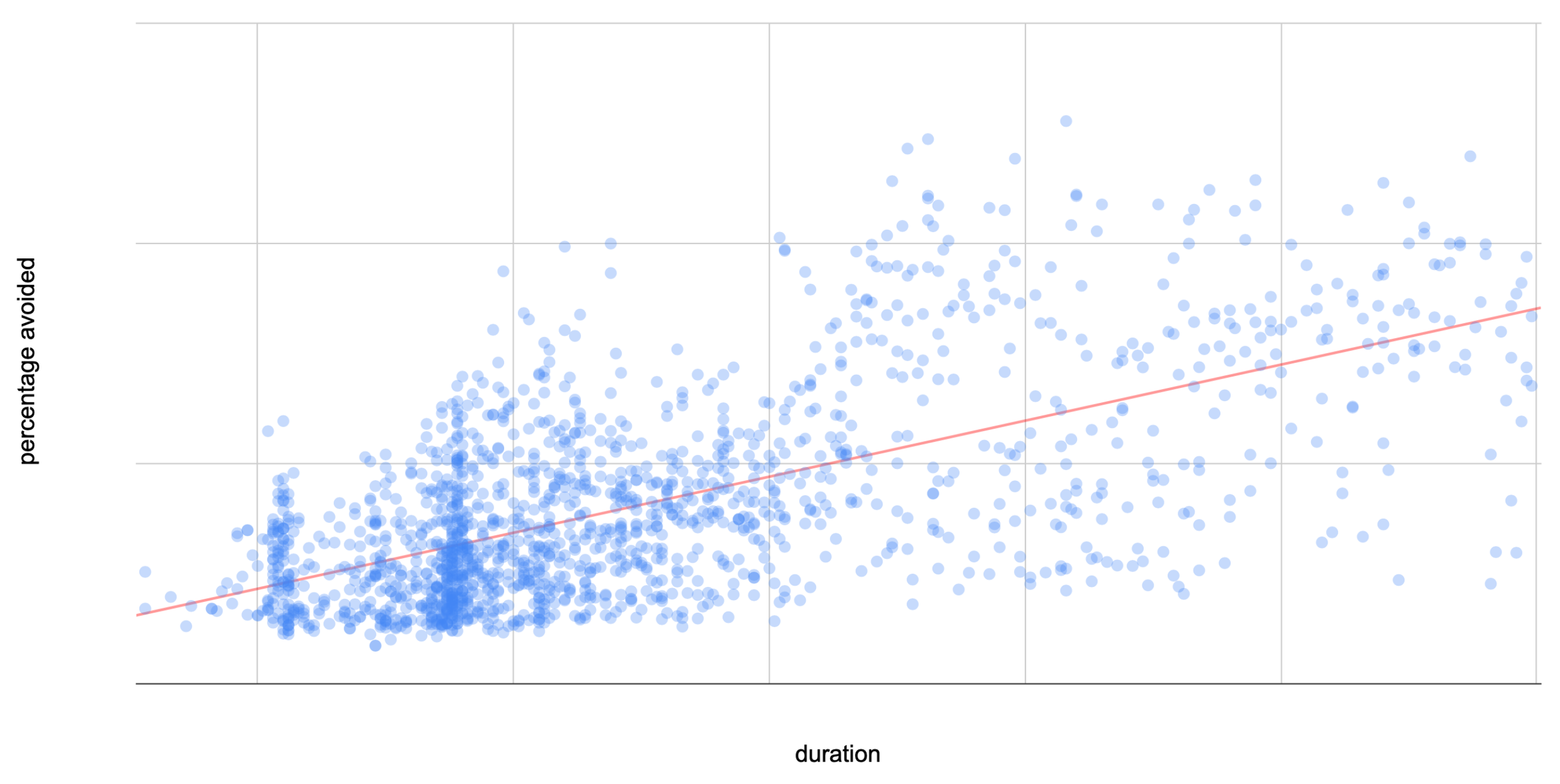
We see a wide spectrum here. But the trend is clear: the longer your ad break, the greater your ad avoidance... and the lower your ad retention.
Of course, if you want to improve your show's ad retention, it's not enough to simply adjust the length and position of your ad breaks. As Sounds Profitable found in their Ad Nauseam research, audiences respond to many different factors: ad load, frequency and repetition, relevance, and entertainment value.
From a technical perspective, there are many other factors that play a much larger role in podcast advertising than just ad skipping. I'll write more about those in the coming weeks.
In the meantime, if you have an ad-supported podcast and are curious about your show's ad retention rate, get in touch.
Remember
Podcast consumers skip ads
Podcast apps share retention histograms that can help podcasters measure podcast ad retention and avoidance
Broadly speaking, longer ad breaks result in lower ad retention
Many shows have very strong ad retention, and should consider sharing this with ad partners