
I recently discussed a common question with a podcast industry friend: “What type of podcast ads are the most effective?”
Should we buy host-read or announcer-read ads? Do pre-roll ads perform better than mid-rolls? Do video podcast ads really perform worse than audio podcast ads? What is the ideal length of the ad break?
At Bumper, we have a very simple answer: the most effective podcast ad is the one that actually reaches an audience.
A few weeks ago Dan wrote about ad retention in podcasting. His post explored how audiences don’t skip ads as much as we think.
A related issue is how many people even make it to the ad. Audiences regularly turn off episodes before getting to an ad that they could skip.
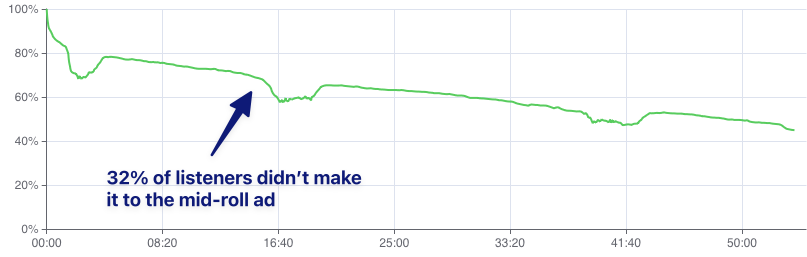
Audiences stop listening to podcast episodes for many reasons: they’re too busy, the content doesn’t meet their needs, it feels too long, or they are only interested in parts of the story. This is not a failure, but a natural part of media consumption. People don’t finish every book they start. Many people still haven’t watched the final season of Mr. Robot.
I was curious about the average listener retention across our industry and how that might impact the efficacy of podcast ads. Fortunately, we get detailed podcast consumption data from the big listening apps and are able to calculate averages across more than 100,000 episodes.
There are different terms for the same metric. Some call it ‘Average Consumption’, other places talk about ‘Audience Retention’. Bumper calls this Average Listen Time.
Listen Time averages across the podcast industry
There is a great story for podcast creators and their advertisers: listener retention in podcasting is amazing, especially on audio-first platforms like Apple Podcasts and Spotify.
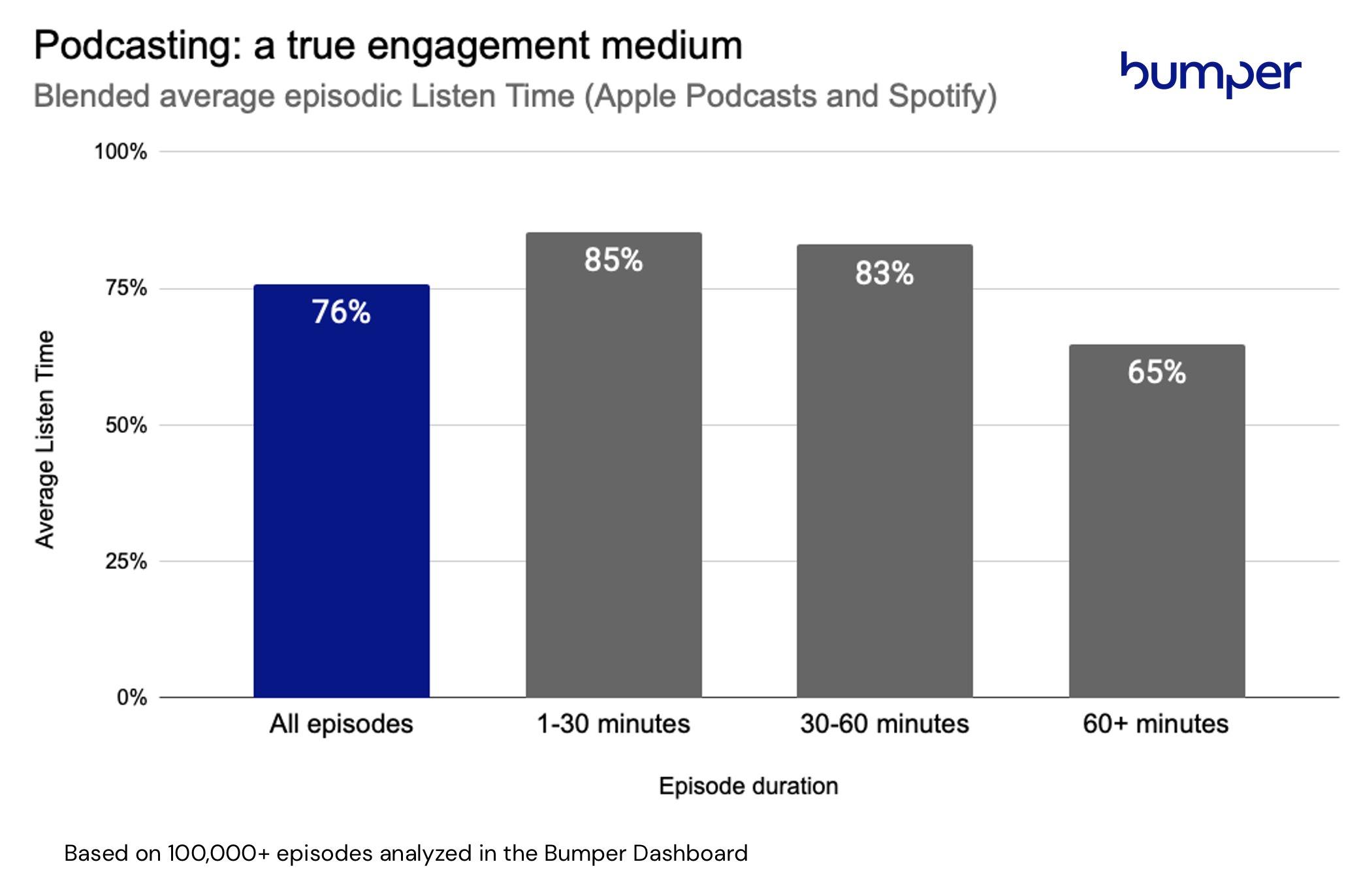
We analyzed 100,000+ episodes and learned that, on average, audiences make it 76% through a podcast episode.
In other words, when someone hits play on Apple Podcasts or Spotify they will, on average, consume 76% of that episode. Podcasting is a true engagement medium.
This blended average is impressive, but it hides details. Strong episodes pull the average up, while weaker episodes drag the average down. The standard deviation is quite high, which means individual episode performance is highly variable. There’s no guarantee a specific episode will perform anywhere near the average. Ad buyers should take care to not be misled.
Broadly speaking, there is a correlation between length of an episode and its average Listen Time. The longer the episode the less likely someone makes it all the way through. Feels like common sense – but what does this look like in reality?
To get a better understanding of the Average Listen Time between different episodes lengths we put episodes into three buckets: 30 minutes or less, between 30 and 60 minutes, and 60 minutes and more.
Here are the average Listen Time numbers for these groups:
30 minutes or less: 85%
30 to 60 minutes: 83%
60+ minutes: 65%
Listen Time performance variations
The above are averages of 100,000+ episodes and act as useful benchmarks. But of course they hide the actionable details: average Listen Time can look very different from episode to episode.
Let’s look at two episodes with similar lengths. The two charts below are retention graphs that show the percentage of our audience that is present at any point of the episode.
The goal? The flatter the retention curve, the better the episode's ability to hold on to an audience.
Most people start an episode at the beginning – we have close to 100% of our audience present at the first second. But over time we see natural audience attrition.
Here’s a retention chart for an episode with exceptional performance. You can clearly see some ad skipping (we call those dips "ice cream scoops”) but overall the majority of the audience makes it through the full episode, even during the ad breaks. This is best-in-class Listen Time performance:
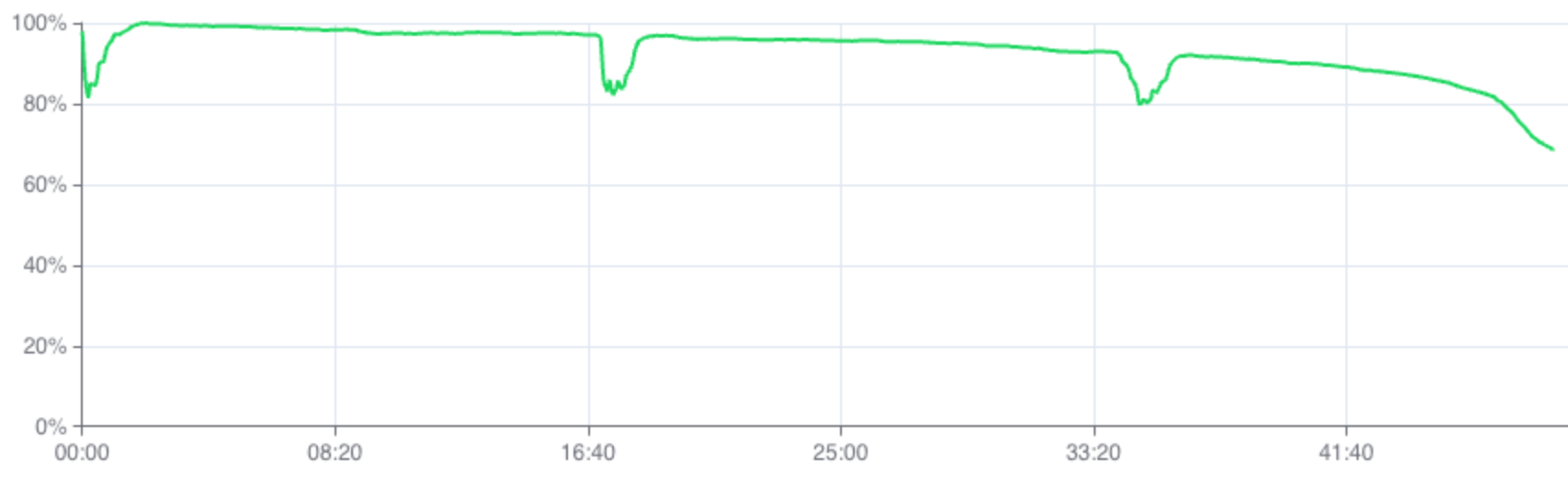
We believe this strong performance is worthy of sharing with any advertisers that are considering buying on this show. This proves strong engagement and a committed audience.
In comparison, the episode below doesn’t perform as well. By the time the mid-roll ad plays about half-way through the episode, over 40% of the audience had already left:

Listen Time data for advertisers
What does this mean for advertisers? Mid-rolls can be a great investment, but because of high variability, they should only be placed within shows with a proven track record of holding audience attention.
Better audience retention doesn’t only lead to more ad consumption (what we are calling Verified Impressions) but it also indicates a loyal, dedicated audience. This type of audience is especially compelling for host-read endorsements. Publishers are able to show their advertisers that the host has influence and impact.
But some episodes do better than others. Your advertisers want to spend money on shows that have an above average ability to hold audiences’ attention. This data is available to publishers from the major podcast listening apps and advertisers can easily ask for Listen Time performance for past episodes.
Optimizing Listen Time
We see average Listen Time as a useful proxy for editorial quality. People tend to listen as long as they enjoy what they hear. The longer they stick around the better – a great way to measure if you are making what your audience is looking for.
The best news? Average Listen Time is something that podcasters have some control over. Through smart editorial and production decisions, average Listen Time can be optimized.
In other words: making better content will result in audiences sticking around for longer and, ultimately, serving our advertisers better. This win-win is actionable and measurable.
Removing information asymmetry
We’re surprised publishers don’t share Listen Time data more often with their advertisers, given the positive stories this can tell. At the same time, advertisers should ask for this information as it helps planning the most effective campaigns.
Reducing this data imbalance between the publisher and advertisers will create trust and increase investment into our medium. Sharing more consumption data with advertisers can create measurable upside for all stakeholders.