
Audiences are moving from radio to podcasts – so why haven't the dollars followed?
Time spent listening to podcasts has now surpassed time spent with AM/FM talk radio in the United States, according to Edison Research's 2025 Share of Ear study. Podcasting has become the medium of choice for talk content.
The audience is already there, so how can we increase the investment in podcasting?
According to 2025 research from Oxford Road, better podcast data could help unlock an additional $1 billion in ad spend.
A trust problem, not a growth problem
We’ve had dozens of conversations with media buyers at brands and agencies over the past year about how better podcast data can unlock bigger budgets. The same questions come up every time from those that control the money: what even is a download? Is an impression the same as a listen? How many people actually heard my ads?
These are not unreasonable questions. They are questions any podcaster should be able to answer. The gap between the audience that podcasters reach, and the audience that advertisers can actually verify, is the biggest obstacle to unlocking that next billion dollars in our industry.
Podcasting needs a viewability moment
There is a useful precedent from the world of digital display advertising.
More than a decade ago, the display ad industry faced a similar crisis of confidence. Advertisers were buying impressions that were never actually seen — ads loaded below the fold, buried in hidden frames, served to bots. Spend was happening, but real exposure was not guaranteed. The industry's response was to establish viewability as a standard: a measurable, auditable signal of whether an ad had a genuine chance of being seen by a real person.
Viewability did not solve every problem in display advertising. But it created a baseline of accountability that unlocked enormous investment into the channel.
Podcasting needs its equivalent.
Introducing the Bumper Score
Today, we are excited to announce the Bumper Score.
The Bumper Score is a measure of how well a podcast delivers ads to a verified audience. It is an independent signal — calculated from first-party data — that offers publishers a way to prove their value and gives advertisers confidence to scale their investment.
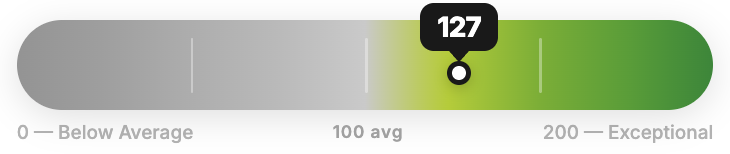
The score ranges from 0 to 200. A score of 100 means a show is performing at the industry average. Anything above that signals a stronger-than-average ability to reach verified listeners with ad content.
How publishers use the Bumper Score
Most publishers already know their audiences are real, loyal, and engaged. The challenge has always been proving that to an advertiser sitting across the table.
The Bumper Score gives publishers a way to do exactly that. It is third-party verification of what you already know, expressed as a single number that any buyer can understand and compare. Publishers can lead with their score in sales conversations, use it as a credible basis for negotiating CPMs, and deploy it as evidence of audience quality. This is especially useful when competing for budgets that might otherwise go to other platforms where some form of verified reach is already expected.
The Bumper Score is particularly valuable in conversations with brand advertisers — those not tracking campaign results through pixels, vanity URLs, or coupon codes. These are exactly the net new dollars that verified audience data can unlock for our industry.
How the Bumper Score works
The Bumper Score answers one question: how well does a podcast deliver ads to a verified audience?
To calculate it, we aggregate first-party data from three sources:
Podcast delivery data from hosting providers
Verified audience data from major podcast platforms
Episode-level retention data to measure actual engagement
Publishers who connect their shows to the Bumper Dashboard receive their score automatically. There is no additional setup or reporting required.
A note on data ownership
Podcasters own their Bumper Score. Nothing identifiable is published by default. This means publishers retain control over their data.
Advertisers and agencies may request to see a Bumper Score as part of a brief or campaign evaluation. But whether to share it is entirely the publisher's decision.
How to get the Bumper Score
The Bumper Score launches as a free service in May 2026. Existing Bumper clients will receive priority access and if you are not yet a Bumper client, the waitlist is now open.